Paul Rourke
Straight ManPaul Rourke is William Henry Devereaux, Jr.’s formidable, long-running antagonist, a colleague whose personal grudges and campus politics repeatedly converge. For years, Devereaux describes their conflict through the image of a boxing ring: Rourke controls the center, while Devereaux stays at the perimeter, escaping direct confrontation through movement, wit, and caution. That adversarial arrangement is real, but not fixed. Rourke’s opposition to Devereaux coexists with occasional political alignment and, near the end, a moment of shared laughter that breaks through their twenty-year performance of hostility.
Identity and Background
Rourke’s anger at Devereaux has a material history. After Devereaux and his family bought adjacent lots using credit-union money, Rourke called three months later to ask if the land was for sale. Devereaux refused. Rourke came to hold him personally responsible for a catalogue of misfortunes: a flooded basement, a fissure in the family-room wall, the muddy drive through the tilting entrance pillars of Allegheny Estates II, and even the gypsy moths. Devereaux jokingly casts Rourke’s worldview as religious despite his claims to atheism: he seems to believe in an evil deity that taxes him with evidence of life’s unfairness, with Devereaux himself serving as a living exhibit.
Rourke’s grievance becomes part of Devereaux’s public persona, too. Rourke inspired the pen name Devereaux used for the Railton Mirror, and calls him Lucky Hank. The nickname makes their antagonism more than a private quarrel: Rourke turns Devereaux into a recurring figure in the newspaper’s satirical view of Railton, while Devereaux turns Rourke into the source of a name that follows him through the story.
Physical Presence and Personal Conflict
Rourke’s size gives their rivalry its physical terms. Devereaux remembers that Rourke once threw him against a wall at the English Christmas party. Since then, the two have avoided taking each other on directly. Devereaux pictures himself running along the ropes as a lightweight, free to dance around the ring so long as he does not enter its center. Rourke, in this account, presents himself as too much of a heavyweight to chase him, but capable of making short work of him if Devereaux ventures too far. Insults, knowing sneers, and taunts preserve the threat without requiring a fight. Devereaux even suspects that Rourke’s leering at his daughter is another deliberate provocation.
A roadside encounter makes that menace immediate. While Devereaux rides with Teddy Barnes, Rourke’s red Camaro tailgates them, swerves dangerously into the passing lane, and cuts back in hard enough to make Teddy brake. Rourke’s second wife is at the wheel, but Devereaux believes she is acting on Rourke’s instructions. When the car pulls onto the shoulder, Rourke gets out; Devereaux, already conscious of his mutilated nose, feels sick at the prospect of being punched. The scene joins the rivalry’s two familiar elements: Rourke’s capacity to intimidate and Devereaux’s wary awareness of what a direct encounter might cost.
Rourke’s aggression also appears in smaller gestures. In the English department office, he studies Devereaux over reading glasses, tosses most of his mail unopened into the wastebasket, and addresses him as “dipwad.” He says he saw Devereaux’s performance the previous night and that it needs work. The exchange is both casual and cutting: Rourke can dismiss Devereaux while remaining absorbed in his own business, as if contempt were an ordinary workplace courtesy.
Campus Politics and Shifting Alliances
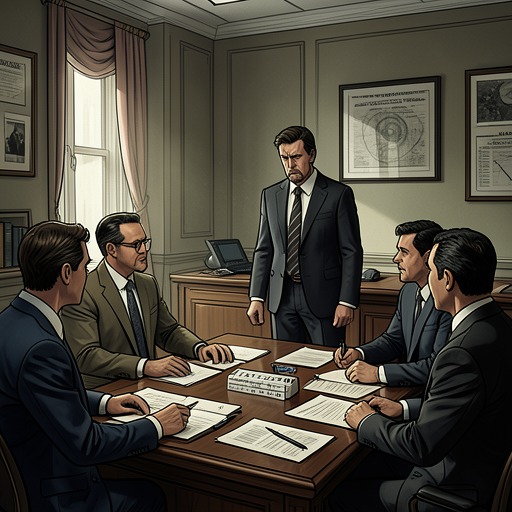
Rourke’s place in the department’s conflicts is not simply that of Devereaux’s enemy. During the faculty-union dispute, Herbert Schonberg approaches Devereaux with Rourke. Their unlikely pairing reflects the abnormality of the moment: Herbert is urgently making his case, while Rourke appears neither to buy nor sell it. Herbert tells Devereaux that some people who agree with him are nevertheless on Herbert’s side, and identifies “your buddy Paulie” as one of them. Rourke had voted against the union. Herbert then argues that Devereaux’s television performance could make him a public point man and that the English department’s large number of votes could help rally support.
The appeal asks Devereaux to choose a side, but the evidence makes Rourke’s position more complicated than personal loyalty. Herbert says that Rourke is among those aligned with them on this issue, while also placing him among the opponents of the union. Devereaux is being recruited because of his visibility and departmental influence; Rourke’s presence shows that an old adversary can belong to a temporary political coalition without the underlying feud disappearing.
Rourke later brings Devereaux news from the same labor struggle at his house in Allegheny Estates. A television news van is on the road, and a police officer is directing traffic at the turnoff. Rourke says Herbert has called to report that the union obtained a copy of the list, and later tells Devereaux that Herbert is calling for a strike vote that afternoon. Rourke thus functions as a source of timely information even as he remains difficult to read. The department’s budget pressures and factional alignments make the list a matter of institutional consequence, while the old personal rivalry determines the wary tone in which the news is exchanged.
His comments also touch the struggle over departmental leadership. At a restaurant, Rourke asks Devereaux how long he has known that the chair search would be canceled. Later, after Teddy Barnes wins a runoff election for a three-year term as chair by one vote, Devereaux describes Rourke as the hostile dean Teddy will have to contend with. Rourke’s influence persists across changes in the chairmanship: the person holding the office may change, but the expectation of his opposition remains.
Vulnerability, Rivalry, and Change
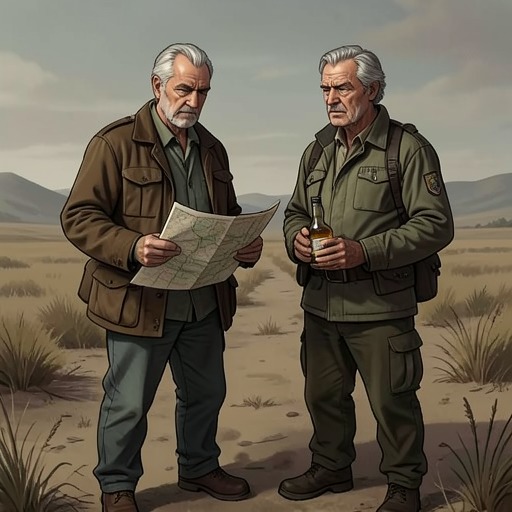
The novel also gives Rourke a body less invulnerable than his heavyweight pose suggests. When Devereaux notices him in the department office after years without a close look, Rourke has more gray hair and fuller cheeks; he seems dissipated, and Devereaux wonders whether he has become a solitary drinker. The observation is speculative, not a confirmed account of Rourke’s habits, but it briefly shifts the perspective from Rourke as looming antagonist to Rourke as a man visibly altered by time.
His health becomes more explicit in connection with fainting spells. After a Sunday basketball game in late June, Devereaux recalls crashing the boards after a missed shot and taking one of Rourke’s elbows. The blow leaves Devereaux with a fractured cheekbone and black eye. He supposes the injury satisfied his old enemy. By the next day, however, Rourke is driving the Camaro again, and his fainting spells have ceased now that he no longer has to breathe his second wife’s secondhand smoke. Physical injury and comic retaliation sit beside this small account of Rourke’s vulnerability; neither cancels the other.
Rourke’s sharp judgments extend to other colleagues. He questions whether a man is “too squared away” or “too emotionally stable,” using psychological stability as a pointed, possibly ironic standard. In another conversation, he predicts that Orshee will receive a year to find other work, reasoning that Orshee’s fashionable cultural-theory writing and smarminess will make him employable. These remarks show Rourke applying the same cutting appraisal to campus life that he applies to Devereaux, though the evidence does not turn his judgments into a neutral or authoritative account.
Reconciliation Without Resolution
The most revealing change comes not in a formal truce but in a moment of recognition. At a gathering where Devereaux introduces Russell to colleagues, he sees Teddy Barnes and Rourke in conversation that seems pleasant—or, at least, nonadversarial. Their exchange does not erase the hostilities of the past, but it makes another mode of interaction briefly visible.
Later, a claustrophobic panic fills the room. Devereaux catches Rourke’s eye across it and grins. Rourke tries to suppress a grin of his own, but the twenty-year resolve that whatever Devereaux found funny could not possibly be funny begins to give way. His large, mean-spirited face opens into a grin, and his shoulders bounce with laughter. The release is small and wordless, not a declared reconciliation. Its force comes from the duration of the resistance: after years of insults, threats, and carefully maintained antagonism, Rourke lets himself share Devereaux’s amusement. The enemy remains recognizable, but no longer entirely sealed inside the role he has performed.